
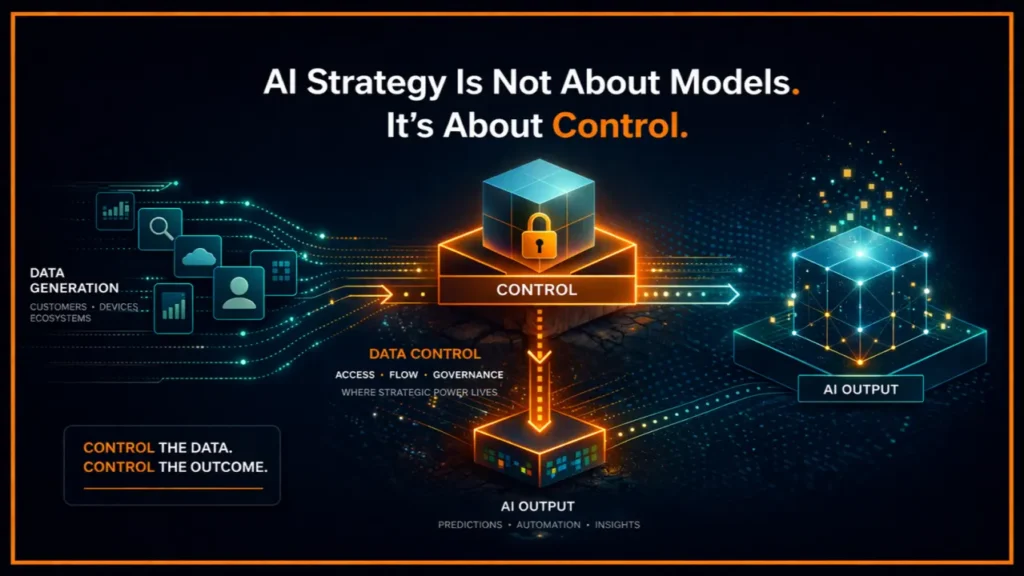
A Strategic Perspective for the Modern CIO
The Hidden Risk in the AI Gold Rush
Most organizations are moving fast on AI.
They are piloting models, partnering with vendors, and investing heavily in automation and analytics.
But beneath this momentum lies a critical and often overlooked risk:
They are building intelligence on top of data they do not fully control.
Artificial Intelligence is often described as the “soul” of the modern enterprise—capable of identifying patterns, predicting outcomes, and helping organizations see around corners.
Yet for many CIOs, that soul is being built on a fragile foundation.
We are generating data at an unprecedented scale. Every device, platform, and interaction produces continuous streams of behavioral and operational signals.
But the fundamental question remains unresolved:
Who actually owns that data?
In the AI era, this is no longer just a legal question. It is a question of control, trust, and long-term enterprise value.
Rethinking Data: From Asset to Responsibility
One of the most persistent misconceptions in AI is that data is inherently an asset.
It isn’t.
Data becomes an asset only when it is governed, structured, and aligned with enterprise strategy.
Otherwise, it is a liability—legally, ethically, and operationally.
Under modern regulatory frameworks such as GDPR and CCPA, organizations do not “own” raw data. They act as custodians, responsible for how that data is handled, protected, and utilized.
This fundamentally reshapes the role of the CIO.
You are no longer just managing systems.
You are managing responsibility at scale.
Organizations that fail to internalize this shift risk building AI capabilities on unstable foundations—creating long-term exposure rather than sustainable advantage.
The 3 Layers of AI Power
To understand where real value—and risk—exists in AI, it is useful to think in terms of three distinct layers:
1. Data Generation
Data is created continuously by customers, employees, devices, and ecosystems. This layer is increasingly decentralized and outside direct enterprise control.
2. Data Control
This is where strategic power resides.
Control determines:
- How data is collected
- Where it flows
- Who can access it
- How it is governed
Platforms, vendors, and architectures often define this layer.
If you do not control it, you do not control your AI outcomes.
3. Intelligence & Value Creation
AI models transform data into predictions, automation, and insights.
However, without ownership or control of upstream data, the value generated at this layer becomes partially externalized.
The key insight:
Many organizations focus heavily on AI models (Layer 3)… while losing control of data governance and flow (Layer 2).
And that is where long-term competitive advantage is determined.
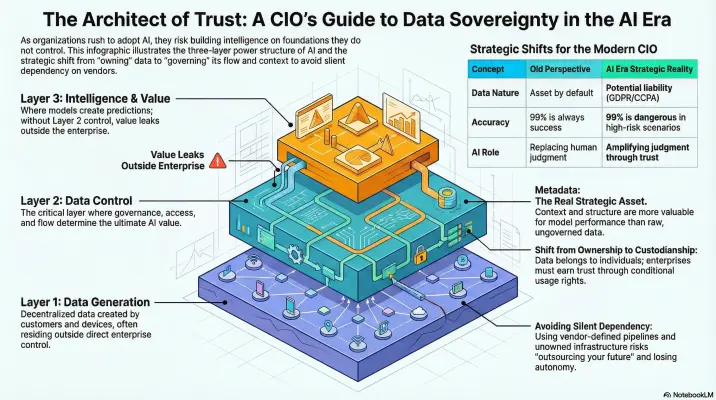
Figure: Why data control—not just AI models—determines enterprise advantage
The Shift to Data Custodianship
The concept of “data ownership” is evolving.
What is emerging in its place is data custodianship—a model where organizations are entrusted with data rather than entitled to it.
This introduces new responsibilities:
- Respecting individual data rights
- Ensuring transparency in usage
- Designing systems that are auditable and correctable
Failure to do so creates what can be described as ethical debt—a compounding risk that eventually manifests in regulatory penalties, reputational damage, or loss of trust.
Metadata: The Overlooked Strategic Asset
While raw data ownership is constrained, metadata represents a powerful and often underutilized asset.
Metadata provides:
- Context and structure
- Efficiency in data processing
- A shared understanding across teams
It transforms raw data into something usable and scalable.
In many ways, metadata becomes the organization’s intellectual layer of understanding—enabling faster decision-making, better model performance, and stronger knowledge continuity.
Organizations that invest in metadata strategy are better positioned to scale AI effectively.
The 99% Fallacy
A common misconception in AI is that high accuracy equals low risk.
In reality, AI systems are inherently context-blind. They identify patterns, but they do not understand meaning.
This creates a critical distinction:
- In low-risk environments, high accuracy is sufficient
- In high-risk environments, even small errors can have significant consequences
The real danger lies in unquestioned outputs—when systems become opaque and difficult to challenge or correct.
The role of AI should not be to replace human judgment, but to enhance and augment it.
Federated AI and the Architecture of Trust
The future of enterprise AI will be shaped not just by performance, but by trust.
Federated AI represents an important evolution:
- Data remains decentralized
- Insights are aggregated rather than extracted
- Value is created without centralizing ownership
This approach aligns with growing expectations around privacy, transparency, and control.
For CIOs, this is not just a technical decision—it is a strategic one.
You are not just building systems of intelligence. You are building systems of trust.
The Strategic Risk of Silent Dependency
The most significant risk in AI is not failure.
It is silent dependency.
Organizations are increasingly:
- Training models they do not own
- Running on infrastructure they do not control
- Relying on externally defined data pipelines
This creates a gradual erosion of strategic independence.
And it often goes unnoticed—until the organization realizes it no longer controls its own capabilities.
Conclusion: Control Defines the Future
As AI becomes central to enterprise strategy, one truth is becoming clear:
Success will not be defined by how quickly organizations adopt AI.
It will be defined by how effectively they control:
- Data architecture
- Data movement
- Data governance
The next generation of CIOs will be those who design systems that preserve data sovereignty, trust, and long-term strategic control.
Because in the end:
If you don’t define your data strategy, your ecosystem will define it for you.
And in the age of AI…
whoever controls the data layer controls the future.