
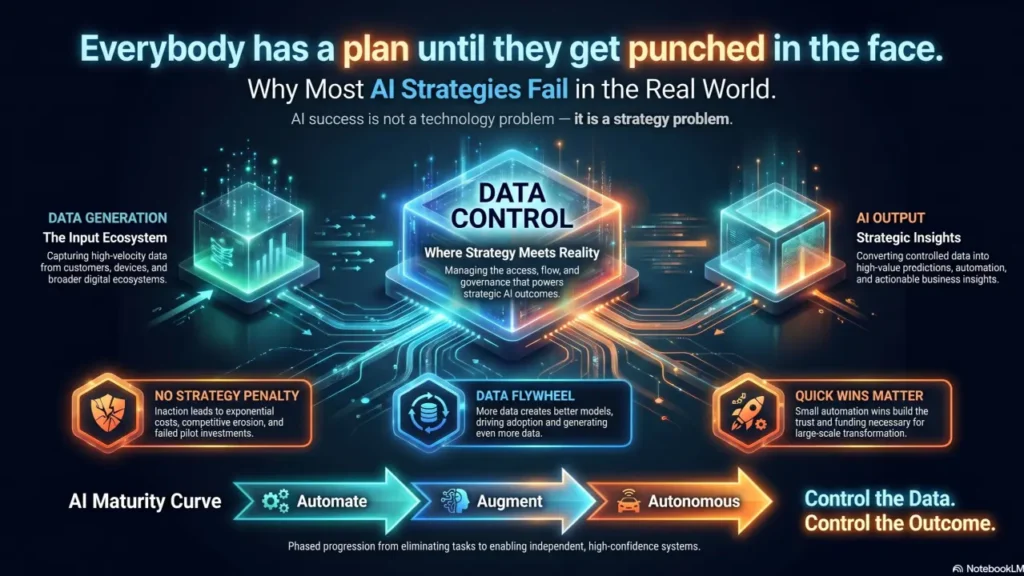
The AI Strategy Gap: Why Enterprise AI Is Failing
The enterprise AI conversation is broken.
Despite billions in investment, nearly 25% of AI initiatives fail outright. Yet organizations that succeed are seeing performance gains exceeding 20%.
This is not a technology gap. It is a strategy gap.
The Real Cost of “No Strategy”
Many organizations approach AI as a procurement decision—buy the platform, deploy the model, expect results.
This mindset is fundamentally flawed.
AI is not a tool. It is a system. And without strategy, that system collapses.
More importantly, organizations that fail to define a clear AI strategy incur what can be described as a “no strategy penalty.”
This penalty is not incremental—it is exponential. It manifests as:
- Wasted investments in disconnected pilots
- Organizational fatigue and loss of trust in AI
- Missed opportunities for compounding data advantage
- Long-term competitive erosion
Even more dangerous is delay. Organizations adopting a “wait and see” approach are unknowingly falling behind in a way that cannot be reversed.
Why?
Because of data network effects.
The Data Flywheel Advantage
AI systems improve through usage. More data → better models → more adoption → more data.
Early adopters create self-reinforcing loops that accelerate over time.
Late adopters don’t just start behind—they start with a structural disadvantage.
This is the new competitive moat.
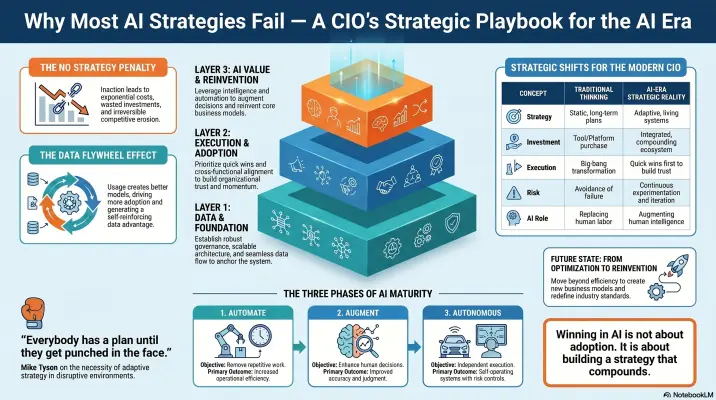
Figure: The layered architecture of AI strategy—from data foundation to compounding competitive advantage.
The reality of AI strategy is best understood not as a single initiative, but as a layered system of data, execution, and value creation.
Why Quick Wins Matter More Than Big Bets
One of the most overlooked insights in AI transformation is this:
Transformation does not begin with large-scale initiatives. It begins with small, visible wins.
AT&T didn’t transform its business overnight. It automated spreadsheet workflows—and unlocked $1B in value.
Quick wins achieve three things:
- Demonstrate value
- Build organizational trust
- Shift cultural perception
Without this foundation, large AI programs fail before they scale.
The Three Phases of AI Maturity
Successful organizations progress through three stages:
- Automate — eliminate repetitive tasks
- Augment — enhance human decision-making
- Autonomous — enable independent systems
The mistake many leaders make is trying to jump directly to autonomy.
But autonomy requires:
- High confidence models
- Low cost of failure
- Extensive real-world training data
In high-risk environments like healthcare, augmentation remains critical.
AI + Data Strategy = Non-Negotiable
AI without data is useless.
Yet internal resistance to data sharing is one of the biggest barriers to success.
The solution is not force—it is design.
Techniques like:
- Federated learning
- Synthetic data
Allow organizations to unlock value while preserving control and compliance.
The Reality of Strategy in a Disruptive World
Even when organizations attempt to create AI strategies, many fall into the trap of rigid, long-term planning.
But as Mike Tyson famously said:
“Everybody has a plan until they get punched in the face.”
AI transformation operates in exactly this kind of environment—dynamic, uncertain, and constantly evolving.
Static plans quickly become obsolete.
What organizations need instead is adaptive strategy:
- Continuous experimentation
- Rapid feedback loops
- Iterative scaling
Strategy in AI is not a one-time document—it is a living system.
The Future: AI as Business Model Innovation
The most forward-thinking organizations are not using AI to optimize existing processes.
They are using it to reinvent business models.
Consider Amazon’s concept of anticipatory shipping: What if products arrived before customers ordered them?
This is not incremental improvement. This is paradigm shift.
Conclusion: Strategy Defines the Outcome
AI success will not be determined by who adopts the most tools.
It will be determined by who builds the most effective strategy.
Organizations that fail in AI are not failing because of technology limitations. They are failing because they underestimate the complexity of execution in real-world environments.
The “no strategy penalty” is not theoretical. It is measurable—in wasted investment, lost momentum, and irreversible competitive gaps.
In an AI-driven world shaped by data network effects, delay is not neutral. It is compounding disadvantage.
The organizations that win will be those that:
- Build adaptive strategies instead of static plans
- Prioritize execution through quick wins
- Align AI initiatives with data foundations
- Treat AI as a continuous system—not a one-time deployment
Because in the end:
AI does not fail in the lab. It fails in the real world.
And in that world—
strategy is what determines whether AI becomes a liability… or a compounding advantage.